


Is Turmeric the Most Effective Natural Anti-Inflammatory for Skin?


30/04/2026
Curcumin, the active compound in turmeric, is a known anti-inflammatory for skin. It can help settle irritation, reduce ongoing inflammation, and support barrier repair over time. But it is not always the perfect fix for every skin concern; it really depends on what your skin needs. And honestly, a lot comes down to how well the formula actually delivers curcumin into your skin.

Introduction
Do you also feel like turmeric is in everything these days, from supplements to your favorite skincare brands? Turmeric has become a true staple for anyone seeking a natural way to calm their sensitive skin. Its secret lies in Curcumin, a powerhouse ingredient that works as a gentle anti-inflammatory for skin. But is it truly the best choice for you? Let's look at the science to see how this sun-kissed botanical can help you find your most balanced glow.

What Makes Turmeric an Anti-Inflammatory Ingredient?
Curcumin is the biologically active compound found in turmeric root. It makes up roughly 2 to 5% of turmeric by weight. When people talk about turmeric skin benefits, it's the curcumin that does the job. Here's how it acts as an anti-inflammatory ingredient:
- A group of proteins called NF-kB is turned off by curcumin. NF-kB controls inflammatory signals in the body.
- When NF-kB is overactive, it keeps the skin in a state of low-level, persistent inflammation. It causes redness, sensitivity, heals more slowly, and breaks down the barrier.
- Curcumin breaks that loop at the cellular level, which is why it can be used to treat so many different skin problems.

How Does Turmeric Compare to Other Anti-Inflammatory Ingredients?
There are so many lovely natural ingredients celebrated for calming the skin. Curcumin certainly sits in wonderful company, but it brings a few unique advantages to your skincare routine. Here is a look at how these ingredients compare:
| Ingredients | Curcumin | Colloidal Oatmeal | Centella Asiatica | Green Tea Extract | Niacinamide |
|---|---|---|---|---|---|
| Primary Mechanism | NF-kB inhibition, antioxidant enzyme upregulation | Barrier support, itch reduction | Wound healing, collagen support | EGCG antioxidant activity | Ceramide synthesis, inflammation reduction |
| Skin Application | Inflammation, pigmentation, barrier repair | Eczema, reactive skin | Barrier repair, redness | UV damage, redness | Barrier, sebum, pigmentation |
| Delivery Challenge | Requires liposomal or encapsulated delivery | Minimal, works topically as-is | Generally well-absorbed | Stability concerns in the formula | Highly stable, widely effective |

Where Does Turmeric Work Best for Skin Inflammation?
Curcumin does not help every skin concern equally. Here is where it makes the most difference:
Skin That Reacts To Everything
Curcumin works by blocking NF-kB, which is like turning down the volume on your skin's alarm system. It addresses what is causing the reactivity instead of just covering it up. When you use it regularly, it lowers that baseline inflammation. Your skin can finally break out of the cycle where it gets irritated, tries to recover, then gets irritated all over again.
Pigmentation After Breakouts Or Irritation
Most dark spots start with inflammation first. While your skin is trying to heal from that irritation, it makes too much pigment in that spot, which is how the dark mark forms. Curcumin helps with both stages. It calms the inflammation that kicks off the whole process and slows down tyrosinase, the enzyme that tells your skin to produce melanin. This double action is especially helpful if you are someone who gets persistent dark marks after any small bump, scratch, or breakout.
Skin Protection From Daily Stress And Pollution
Every day, the sun, smog, and even normal aging can cause oxidative stress on your skin. This makes free radicals, which damage your skin cells and make the redness or inflammation worse.
Curcumin acts as an antioxidant. It helps neutralize those free radicals before they can cause harm. This means it is not just calming existing inflammation but also helping prevent new damage from building up in the first place.
Damaged Barrier Repair
When your skin barrier is compromised and you are dealing with sensitivity at the same time, you need something that tackles both problems at once. It calms the inflammatory response right at the skin level, which applies directly to everyday reactive and barrier-damaged skin, too.

Did You Know Turmeric Was Never Actually Made for Your Skin?
Nature did not design curcumin for your skin. It evolved as a plant defense molecule. Growing in humid, tropical soil, the root needed to defend itself from:
- Fungal attacks in the ground
- Bacterial threats in its environment
- Intense UV stress from tropical sun
Now, here is where it gets relevant to your skin. Those are the exact same stressors your skin deals with every single day. UV damage, microbial imbalance, and environmental inflammation. A molecule built to protect a root maps almost perfectly onto what human skin needs.
And do you know Curcumin exists almost nowhere else in nature? It is almost entirely unique to the turmeric plant. That rarity is part of why it keeps showing up in skin research. It is specific, concentrated, and built to fight stress from the inside out.

Does Formulation Affect the Anti-Inflammatory Effect of Turmeric?
Turmeric on its own doesn't blend well with water-based formulas, which means it often just sits on the surface. For it to actually calm inflammation, it needs to be paired with skin-friendly lipids that your skin can recognize and absorb, since your skin is made of these fats.
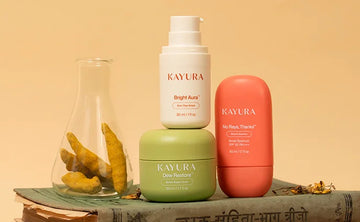
That's exactly why Dew Restore Haldi Hydration Essence is built with ceramides and biomimetic lipids to help actives like turmeric go deeper and work where it truly matters.

The Takeaway!
Turmeric is not hype. It works when curcumin is extracted properly, delivered deep enough to actually reach your skin cells, and used consistently over time. If your skin deals with redness, slow-healing marks, or inflammation that never fully settles, curcumin is genuinely worth adding to your routine. Explore Kayura's clinically tested sensitive skin range, crafted with advanced delivery systems so the product you apply actually reaches its target and shows real results!

Also Read:
More Useful Links:
Haldi Hydration Essence | Dew Restore Barrier Repair Cream | Bright Aura Even Tone Serum
Frequently Asked Questions
Yes. Curcumin inhibits NF-kB, the protein complex that controls inflammatory signals at the cellular level. Clinical studies confirm measurable reductions in skin inflammation markers with consistent topical curcumin use over eight weeks.
Both are effective but work differently. Niacinamide stimulates ceramide production and reduces sebum-related inflammation. Curcumin targets the deeper NF-kB inflammatory pathway and also addresses oxidative damage. They complement each other well in the same routine.
No. Curcumin is a well-supported natural active, but it is not equivalent to prescription-strength anti-inflammatory treatments for conditions like severe eczema or rosacea. It works best as a preventive and supportive ingredient within a considered routine.
Most people notice visible improvement in redness and reactivity within 4 to 6 weeks of consistent daily use. For deeper concerns like post-inflammatory hyperpigmentation, expect 8 to 12 weeks.
Yes, when properly formulated. A well-encapsulated topical curcumin product is generally very well-tolerated, including on reactive and sensitive skin. Always patch-test any new product before full application.


Dew Restore™ Essence
Haldi Hydration Essence


Karma Boost™
Vitamin C + Antioxidant Serum


Golden Legacy™
Traditional Scalp & Hair Oil


No Rays, Thanks™
Mineral Sunscreen SPF 50 PA++++


